thank god it's thursday
I was told I would need to come in my most conservative clothes and with my head veiled. So my first stop was a hijab stall at the Hammidiyyeh Souq.

The owner wisely deemed anything involving a scarf and pins too complicated for a novice. A popular 2-piece option was quite stylish, but (even) more binding than the 1-piece hijab-to-go I ended up with.
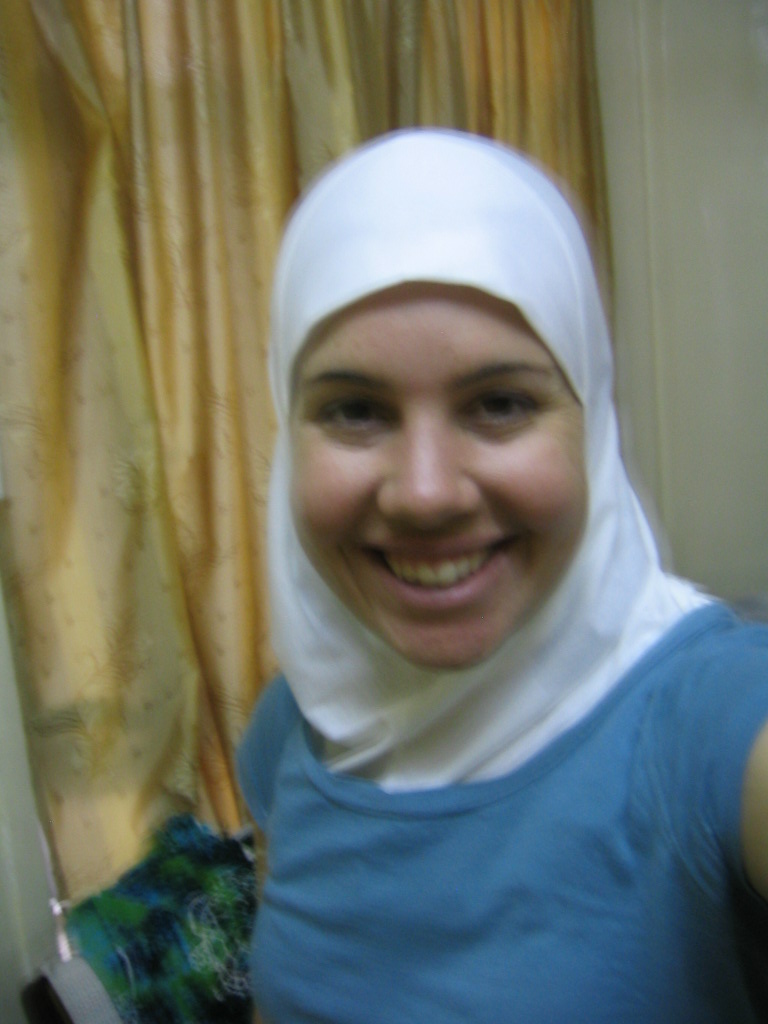
Fetching, no?
Hijab-in-hand, I made my way out of the Souq and caught a taxi to the Mosque Abu Noor to meet E. Having made the mistake of not be-hijabing in the taxi, I found myself in the awkward situation of being the only unveiled woman in a crowd, with no place to change. I felt like Superman without a phone booth. Desperate, I ducked into a particularly leafy tree and nearly throttled myself getting the thing on.
The most disorienting thing about hijab is that it muffles your hearing. Not only are you hidden, your own sensory perception is constrained. Unsettling and unpleasant.
E arrived and we caught a "hyoondai" partway up Mount Qassioun, which is the Northern boundary of the city and sprouting settlements partway up its sides. The ones we were in are mostly concrete squatters' communities--but BUILT as such by the government. The hyoondais (usually Subarus) are used because regular services can't handle the slopes. As mini:car:: hyoondai:truck. They have a cab, a small platform on back, and no front, so that when they slam to a stop, your (own) nose ends up about 6 inches away from the slightly disgruntled pedestrian in front of you.
We were met by a Sufi Sheik: bearded, green-turbaned, with a long shirt, vest, and baggy trousers. He led us to the small Sufi zaawiya (literally, "corner") and showed us the wali of Sheik Daghstaani. For the service, the women are segregated from the men on a broad balcony above the main room, which is carpeted and decorated with caligraphic hadiths. The ziqra was about an hour's worth of Qur'anic readings and group chantings. The women say their own prayers and peer over the balcony. You can't see much. So far as I can tell, there wasn't any spinning, but it was still fascinating, in a surreal way. Especially because afterwards I returned to the bright, bare-headed nightlife of Bab Touma.
Which is when part 2 of the evening begins (really, it's worth reading on). After abandoning my hijab, I headed to dinner with a friend from the program here. However, we got distracted en route by part of the "fete de la musique": a one night, city-wide collection of musical events, in imitation of the wildly popular french versions. Spent a while listening to traditional warbling vocals in the palatial courtyard of nineteenth-century merchant's house. After dinner, more rhythmic, jangling sounds drew us into a cafe, crowded with an enormous variety of groups: extended families, 20-somethings, and older couples. As the music moved to contemporary local favorites, the small space in the center of the room became an impromptu dance floor, first populated by young girls (already spectacularly adept at Middle Eastern shimmying). Then, when a dubka (arabian line dance) was played, other people joined in: including, at the insistence of the owner, us! Once again, the Balkan folk dance classes pay off!
As the volume rose, the circle of dancers accelerated, and some of the girls took to the tables. The owner switched off the main lights and flipped on a multi-colored disco ball--kept on hand for these occasions?? A flailing foot bumped a sheesha, sending coals tumbling to the floor. We decided it might be wise to depart before they literally burned the place down, so begged off around 1:30 am, as the large family's dinner was being served.
posted by Emily at 7:13 PM


1 Comments:
You're the best ever--how have you packed so much into such a short time? I would have been turtled with vocab cards; your way is a lot more fun.
Tell me it's okay to give the url to the class, so they can enjoy also...? And thanks for all the fun!
K. H.
Post a Comment
<< Home